One Step at a Time: The Volunteers Rebuilding the School Run on Foot
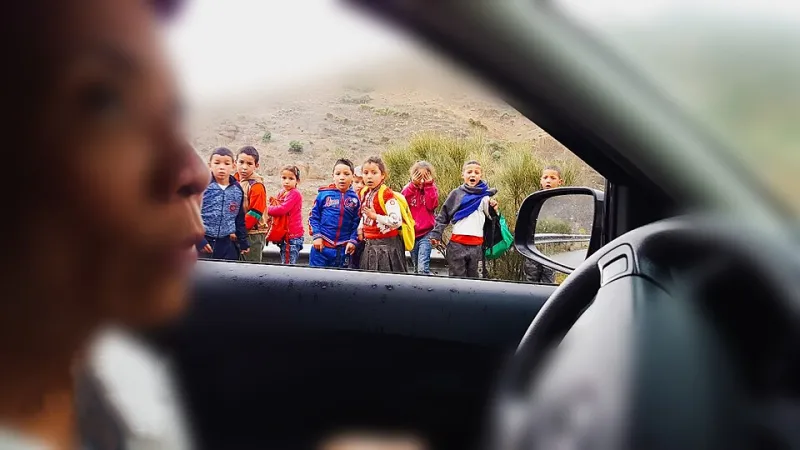
Photo: Amirab87, CC BY-SA 4.0, via Wikimedia Commons
The first thing you notice is the whistle. Not a referee's blast — something softer, a short two-note call that carries about fifty yards down a terraced street. By the time you reach the corner, four children are already waiting, coats zipped, book bags swinging, and one very patient volunteer in a fluorescent vest is checking names against a clipboard that has clearly been rained on more than once.
This is the 8.15 route, and it is small. Two adults, six children on a good day, four on a wet one. It takes twenty-two minutes door to gate. And according to the parents who rely on it, it has quietly changed the shape of their mornings.
Eight Feet and a Whistle
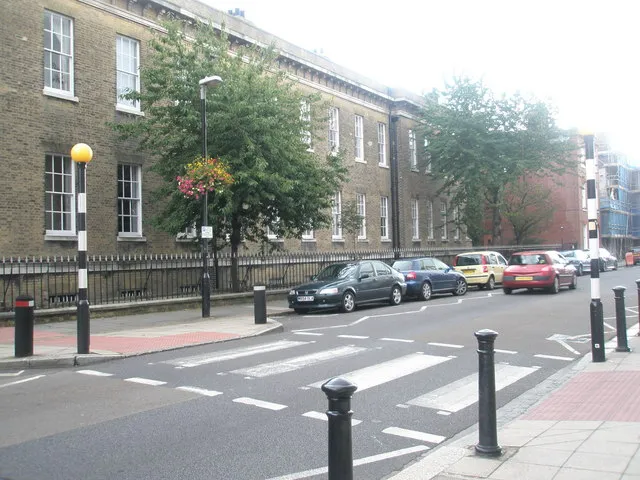
The idea behind a walking bus is almost embarrassingly simple. Instead of six separate cars converging on one school gate at the same time, one adult walks a fixed route with a 'station' at each corner. Children join along the way. A second adult brings up the rear — the back marker — so nobody gets left behind or wanders off at the pelican crossing.
On this route, the leader is a grandmother called Denise, who has done it for three years and knows exactly which paving slab lifts in frost. The back marker today is a dad named Owen, who took the morning slot because his employer moved him to a later start. He admits he thought it would be boring. It isn't.
"You hear everything," he says. "Who's fallen out with who. Which teacher does the best voices at story time. You find out more about your own street in twenty minutes than you do in a fortnight of driving past it."
Why Families Are Signing Up Again
Walking buses are not new. They appeared in the 1990s, peaked, faded, and are now finding a second life for reasons that have very little to do with nostalgia.
First, there is the traffic. Streets around school gates in 2026 are congested in a way that has become a genuine safety concern, and several councils have introduced 'school street' restrictions that close the road to cars at drop-off and pick-up. If you cannot drive to the gate, you need another way to get there.
Second, there is the cost. Not every household has a car, and of those that do, plenty have decided that a second one is a luxury too far. A walking bus costs a family nothing.
Third, and perhaps most surprisingly, there is the time. Parents who use the route describe it less as a favour and more as a straight swap: twenty minutes of walking in exchange for twenty minutes of queuing, parking, and reverse-parking out of a side street while somebody's hazard lights flash at you.
"I get to work no later," says one mother of two who joins at the second stop. "But I get there in a much better mood. And so do they."
The Paperwork Behind the Pavement
What surprises most people who inquire about starting a route is not the walking. It is the admin.
Volunteers are typically recruited through the school office or the parent-teacher association, and they are subject to the same safeguarding checks as anyone else working with children — an enhanced DBS check, references, and a conversation with the designated safeguarding lead. Most schools also ask volunteers to complete a short induction covering the route, the crossing points and what to do if a child does not turn up.
Insurance is the question that stops more schemes than anything else. In practice, most walking buses run under the school's public liability cover, with the local authority's school travel team advising on the risk assessment. The assessment itself is refreshingly practical: which junctions, which pavements, where the group waits, what happens in fog, and the golden rule that there are always at least two adults on the route, no exceptions.
There is also the rota. A walking bus lives or dies on its rota, and every coordinator we spoke to said the same thing: build it for the parents who can do one morning a fortnight, not the hero who promises every day and lasts three weeks.
The Conversations You Can't Have in a Car
The children, it must be said, are less interested in insurance. What they like is the procession. There is something about walking in a loose crocodile with a whistle at the front that feels faintly official — a small daily parade of their own.
And the talk along the way is different from the talk in a car. Nobody is strapped in facing forward. Nobody is concentrating on a junction. A child can ask a question and receive a full answer rather than a distracted 'mmm'.
On the morning we walked, the topics covered in twenty-two minutes were: whether a dog can be embarrassed, what the oldest tree on the street might have seen, and why the school's reception class has a pet snail called Gerald. Denise fielded all three with the calm of a woman who has been asked stranger things before nine o'clock.
A Small Thing That Holds
Walking buses will not solve the school run. They suit certain streets, certain schools, certain families, and they collapse the moment volunteers dry up. But where they work, they do something that is hard to put on a travel plan.
They make a road into a route. They turn a set of anonymous front doors into stops on a line. Children learn which house has the friendly cat and which gate sticks in the rain. Parents learn each other's names.
"It's a small thing," says Owen, as the whistle sounds at the last corner and six children peel off towards the gate. "But it's the only bit of my day where nobody's asking me to be efficient."
If your school is considering a route, start with the office and the school travel team, keep the first version short, and be honest about how many mornings you can genuinely give. Eight feet, a whistle and a wet clipboard may not sound like much. Most mornings, it is exactly enough.